 Awqaf New ZealandAwqaf New Zealand

This working paper argues that vocational education and training (VET) should be treated as enabling infrastructure for a capable, accountable and socially productive Awqaf industry, and that women should lead that infrastructure rather than merely benefit from it. Drawing on Awqaf New Zealand's history, from a 2005 refugee wool-and-heritage proposal in Christchurch, through a 2011 cooperation protocol that committed its parties to the use of unused Qurbani resources, heritage exhibitions and the role of Muslim women in Awqaf, to its current Qurbani measurement and sheep-dairy feasibility work, the paper sets out a five-domain skills architecture and applies it to eight areas of interest: the Qurbani industry, sheep dairy farming, waste management and maximum utilisation, heritage skills preservation, AI tools, Google for Nonprofits, social finance and the UN Sustainable Development Goals. It gives particular attention to Awqaf NZ's historical, unimplemented proposal for a Heritage Skills International Touring Exhibition, under which refugee women's craft products would be shown in international cities and 80% of distributable proceeds would go to the woman artisan and 20% to women's community development, and it explains why vocational training is what would make such a model viable and fair. It proposes a stackable pathway from participant to trainer and trustee, a research-to-pilot sequence and an indicator set. It distinguishes historical activity from untested proposals throughout, and offers a research and pilot agenda rather than claiming demonstrated impact.
Keywords: Awqaf; waqf; vocational education and training; women's leadership; women's economic empowerment; refugee women; touring exhibition; Qurbani; sheep dairy; resource utilisation; heritage skills; artificial intelligence; Google for Nonprofits; Islamic social finance; Sustainable Development Goals; institutional replication
The term "Awqaf industry" is used here as a proposed systems concept: the interconnected institutions, skills, services, governance arrangements, assets, supply chains and beneficiaries involved in establishing, administering and deploying waqf resources for public benefit. It does not imply that Awqaf constitutes one legally uniform industry across countries.
The central proposition is that capital and charitable intention alone do not create sustainable public value. People need practical capabilities to design, govern, operate, maintain, evaluate and improve the activities supported by Awqaf. Vocational education and training is therefore a strategic complement to waqf finance, research and governance, and not an optional charitable add-on.
The paper was written in response to a practical question put by Awqaf NZ's Secretary-General: how can vocational training help empower women in the Awqaf industry across the specific areas that matter to Awqaf NZ, and what more could it achieve? The answer is organised as follows. Sections 2 to 5 set out the history, the case for VET, the principle of women's leadership and the skills architecture. Section 6 applies them to eight areas. Sections 7 and 8 map them to the SDGs and extend them. Sections 9 to 13 describe the pathway, the delivery model, the pilot sequence, the measures and the safeguards.
At a community development meeting in Christchurch around 2005, an arrangement was described under which New Zealand sheep farmers would donate wool so that refugee families, Afghan and Kurdish communities in particular, could keep alive the textile and craft skills they had brought with them, with older women passing wool and leather work, including natural dyeing, to younger ones. The skills and the need were real. The proposal did not proceed, largely because sheep country was then being converted to dairying and the wool was not reliably available. It is recorded here as a heritage-preservation and intergenerational-learning proposition, not as evidence of a completed training programme.
The lesson drawn from it shaped what followed: wool, hides and other non-meat parts of the sacrificial animal already existed in very large quantities each year at the Qurbani, and were widely discarded. The material a refugee craft programme could not obtain was being thrown away elsewhere.
Awqaf NZ became a registered charitable trust in New Zealand in 2011 (CC46694). In the same year it signed a cooperation protocol with a government Awqaf foundation in Dubai (AMAF). Article 5 of that protocol commits both parties to cooperate on the use of the unused parts of animals slaughtered for Qurbani and charity, with the proceeds added to the waqf; on mobile charitable exhibitions concentrating on traditional heritage; on encouraging and developing the role of Muslim women in the field of Islamic Awqaf; on organising training courses; and on developing New Zealand as a model to be shown to Muslim communities elsewhere [1]. Zero waste, the heritage exhibition, women's leadership, training and replication are therefore written into an instrument signed fifteen years ago, not framing added recently.
In late 2012 a planned 1,000-head trial could not proceed at the scale intended, and a ten-animal trial was run at Stratford, Taranaki, on 2 November 2012; the hides went to students at an Auckland girls' college for heritage work [2]. In 2014, a tender prepared with an endowment-founded New Zealand farm that has run a residential cadet school since 1919 proposed training up to thirty new agricultural students a year [2]. These episodes form part of Awqaf NZ's history; they do not establish validated commercial or livelihood outcomes.
From these strands Awqaf NZ developed, as a proposal, the concept of a Heritage Skills International Touring Exhibition: work made by refugee women, including textile and leather craft and the natural dyeing of wool and hide, would be shown and sold in international cities, with London, Paris and Sydney named as the markets in contemplation, and most of the proceeds returned to the women who made the work [2]. The concept was never implemented. No exhibition has been held, no product sold and no proceeds distributed. Section 6.4 sets out the model in full, and section 6.4.6 returns to the 2005 idea itself, proposing two small pilots that would test intergenerational heritage learning for refugee-background girls and young women today.
| Year | Documented | Proposed, not implemented |
|---|---|---|
| c. 2005 | Christchurch community meeting describes donated wool for Afghan and Kurdish refugee families' craft skills; proposal does not proceed | Intergenerational wool and textile training for refugee families |
| 2011 | Awqaf NZ registered (CC46694); cooperation protocol with AMAF signed, Article 5 covering Qurbani by-products, heritage exhibitions, women in Awqaf and training | Mobile charitable heritage exhibitions |
| 2012 | Ten-animal Taranaki trial; hides to an Auckland girls' college for heritage work | A 1,000-head trial (not run at that size) |
| After 2005 (undated) | The touring exhibition concept recorded in Awqaf NZ's institutional account [2] | Touring exhibition in London, Paris and Sydney; 80% to the artisan, 20% to women's community development |
| 2014 | Tender with an endowment-founded cadet farm proposing up to 30 agricultural trainees a year | The farm and training programme (the station was sold elsewhere) |
In 2026 Awqaf NZ published the Qurbani Utilisation Index (QUI-Awqaf NZ), a proposed method for measuring what becomes of the Qurbani animal, built on the FAO approach to SDG indicator 12.3.1(a) [3]. It is a measurement methodology, not a measured global wastage rate. A feasibility study for a Qurbani sheep-dairy pilot has also been published for open critique [4]. No farm is operating and no capital has been deployed.
VET translates a resource into an employable skill and a potential service or product. In Awqaf-related settings that may include animal husbandry and welfare, food safety, milk harvesting and processing, wool and hide handling, textile production, equipment maintenance, financial administration, digital communication, logistics and evaluation. These are distinct occupations requiring different trainers, standards and safeguards.
Training must not be reduced to short workshops or attendance certificates. Quality pathways specify occupational competencies, supervised practice, assessment, recognition of prior learning, decent-work conditions and access to further education. The International Labour Organization's Quality Apprenticeships Recommendation, 2023 (No. 208), a Recommendation rather than a binding Convention, provides a useful international benchmark for structured and protected apprenticeships [5]; local law and national qualification frameworks remain decisive.
Three features of VET make it especially suited to the Awqaf industry:
Awqaf NZ is not a registered training organisation and does not intend to become one. Accredited delivery would be through approved providers in each jurisdiction. Awqaf NZ has identified potential registered training organisations (RTOs) in Australia, and potential accredited providers in Canada through its sister organisation, the Canadian Awqaf Foundation (https://canadianawqaf.org). These are exploratory contacts; no provider is committed and no programme exists. Its Secretary-General is enrolled in the Australian Certificate IV in Training and Assessment (TAE40122), with completion expected in December 2026, which gives the institution in-house competence to specify units, review assessment design and work with providers on equal terms, without itself awarding qualifications.
The 2005 heritage concept placed women's knowledge and intergenerational transmission at the centre, and the 2011 protocol made the role of Muslim women in Awqaf an explicit field of cooperation [1]. This paper treats women's leadership as a cross-cutting principle rather than a separate project: every area in section 6 names roles women can lead, not only roles in which they participate.
The central argument of this paper, applied to women, is a progression. Many refugee and migrant women already hold valuable knowledge. Vocational training should enable them to move from knowledge holders to paid trainers, entrepreneurs, enterprise managers and institutional leaders, including trustees of the funds that serve their communities. Awqaf NZ's touring exhibition proposal (section 6.4) is the clearest historical expression of this idea: heritage skills should not merely survive, but become a pathway to economic independence and leadership.
Awqaf France, registered in Paris in 2016 and founded at Awqaf NZ's request, has developed under women's leadership; this is part of Awqaf NZ's account of institutional replication. Historic formation documents do not, by themselves, verify its present board composition.
Evidence from outside Awqaf supports the direction. The FAO's 2023 report on the status of women in agrifood systems found that women face persistent gaps in access to land, inputs, finance, training and technology, and, in a modelled scenario, estimated that closing the gender gaps in farm productivity and in agricultural wages could raise global GDP by about 1 percent, nearly US$1 trillion [7]. This is a global estimate, not a projection for any Awqaf programme. Agriculture and food are exactly where several Awqaf NZ priorities sit.
| Domain | Indicative competencies | Leadership roles for women |
|---|---|---|
| A. Institutional stewardship | Trusteeship and waqf administration; accounting and reporting; risk and procurement; safeguarding; compliance; impact measurement | Trustee, finance officer, compliance and safeguarding lead, impact analyst |
| B. Productive and agricultural systems | Livestock husbandry and welfare; milk harvesting and hygiene; dairy processing; food safety; pasture and fodder; cold chain and traceability; safe use of by-products | Farm technician, herd manager, dairy processor, quality officer, farm business manager |
| C. Heritage and livelihoods | Wool sorting, spinning, felting, weaving, natural dyeing; sewing; leather work where safe and lawful; recognition of prior learning; quality assurance and product development; design; costing and pricing; enterprise skills; exhibition curation and logistics; digital marketing and storytelling; heritage documentation with consent; intellectual property and cultural rights | Paid master artisan and trainer, designer, enterprise or cooperative manager, exhibition curator, member of a women-governed community fund |
| D. Digital and AI capability | Data literacy; multilingual learning media; workflow automation; cybersecurity and privacy; research verification; responsible AI use | Digital coordinator, data and measurement specialist, content producer, AI-literate trainer |
| E. Training of trainers and replication | Pedagogy; competency-based assessment; RPL; mentoring; partnership management; locally adapted curricula | Trainer and assessor, curriculum designer, programme coordinator, replication adviser |
The domains are deliberately broad. Each programme would select the units it needs from recognised qualifications in the relevant jurisdiction rather than invent its own.
For each area below the paper sets out the opportunity, the skills involved, the roles women can lead, a realistic training route and the main safeguards. The routes are illustrative; units and levels must be confirmed with accredited providers in each country.
Opportunity. Each year, over a few days, a very large number of animals are sacrificed worldwide, much of it arranged by charities and service providers on behalf of people who never see the animal. Quality depends on procurement, animal welfare, timing, food safety, distribution, record-keeping and honest communication. Awqaf NZ's work on an international framework for the terms and conditions of Qurbani services [8] shows how much of this rests on staff who understand both the rules and the practice.
Skills. Livestock sourcing and welfare in transport and lairage; food safety and hygiene; cold-chain management; distribution logistics; order and records management; traceability and evidence for donors; consumer-law and terms-of-service compliance; complaint handling; multilingual customer communication.
Roles women can lead. Qurbani service manager; welfare and quality officer; traceability and records lead; distribution coordinator; customer communication lead. Roles at the point of slaughter are subject to Shariah guidance and local regulation, and this paper takes no position on them.
Training route. Short micro-credentials (food safety, animal welfare awareness, records and traceability) leading to certificate-level units in supply chain or agrifood operations, with supervised practice during an actual Qurbani season.
SDG 2SDG 8.5SDG 12.3
Opportunity. Awqaf NZ's published feasibility study and discussion paper examine a Hijri-aligned Qurbani sheep-dairy pilot that would turn seasonal Qurbani demand into year-round production [4][9]. The obstacle in 2005, sheep country turning to dairying, is one a sheep dairy resolves rather than fights. A farm also produces two things a measurement cannot: people who know how to run one, and the next generation of farm leaders.
Skills. Ewe husbandry, lambing and animal health; milking routines and milk hygiene; on-farm records and livestock identification; pasture and fodder management, including feasibility research on hydroponic fodder; farm health and safety; dairy processing into yoghurt and cheese; farm business and compliance.
Roles women can lead. Dairy farm technician; herd and animal-health lead; milk quality and processing lead; artisanal cheesemaker; farm business manager; future farm manager.
Training route. A cadetship or apprenticeship model in which trainees complete recognised agricultural units while working on the pilot farm under supervision, following the precedent of the endowment-founded cadet farm described in section 2. A scholarship, with criteria Awqaf NZ helps design and a placement expectation, is the ordinary instrument for linking training to the farm's future workforce. The proposed Charles Sturt University work is a feasibility and research question, not an operational or scientifically validated farm.
SDG 2.3SDG 2.4SDG 4.4SDG 5.5SDG 8.6
Opportunity. Awqaf NZ's mission is turning unused or wasted charitable resources into sustainable waqf revenues. The QUI proposes to measure, rather than assert, what becomes of the Qurbani animal [3]. Measurement itself is skilled work: it needs trained people to count, record, sample and verify.
Skills. Loss and waste measurement and survey methods; data recording and quality checks; hide preservation and grading; wool classing; safe handling of by-products and biosecurity; composting and other circular-economy processes; environmental compliance; basic cost and value analysis.
Roles women can lead. Measurement and data officer; by-product and quality supervisor; environmental compliance officer; circular-economy enterprise manager.
An honest limit. The feasibility study's own estimate is that wool from a 300-ewe flock would be worth about NZD 2,600 a year, which funds nothing on its own [4]. The value of utilisation work lies first in measurement and skills, and only later, at scale and where lawful, in revenue.
SDG 12.3SDG 12.5SDG 8.3
Opportunity. The UNESCO 2003 Convention defines intangible cultural heritage to include traditional craftsmanship, and stresses its transmission from generation to generation [10]. The Convention does not itself designate any particular craft; recognition rests with the communities concerned. Wool and hide crafts held by displaced communities are at risk when the material, the time and the younger learners are missing. This was Awqaf NZ's founding concern, and the touring exhibition was its proposed answer.
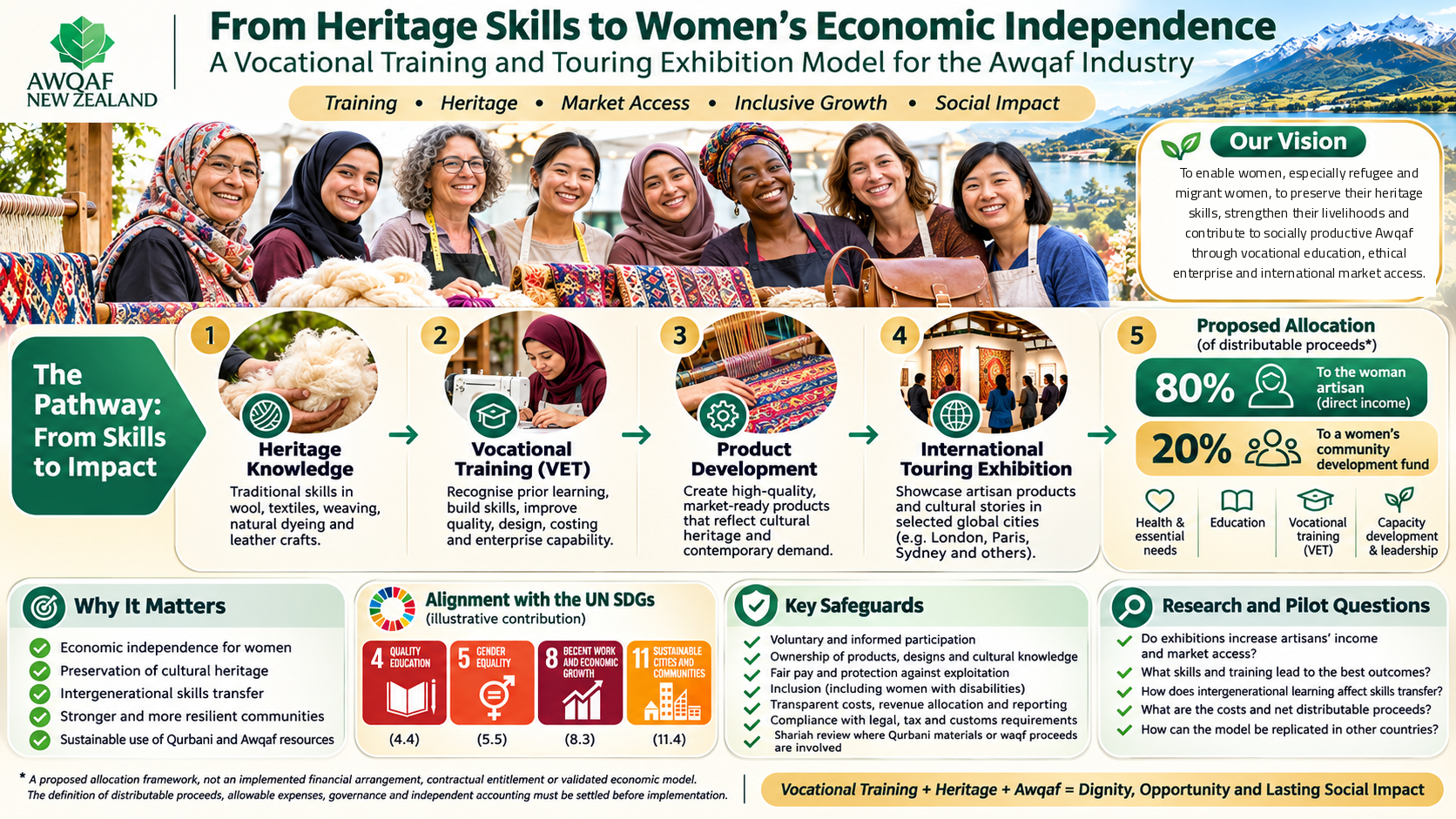
The Heritage Skills International Touring Exhibition and Women's Economic Empowerment Model is a five-step pathway (Figure 1):
The market hypothesis. The model rests on a hypothesis: that handmade heritage products may command greater value in markets where customers appreciate craftsmanship, cultural heritage, provenance and the artisan's own story than in the markets available to women living in refugee camps, where opportunities to earn are often very limited. This is untested. Awqaf NZ holds no price data, sales results or demand estimates for such products, and none are assumed here. The hypothesis must be tested against real costs, including transport, insurance, customs duties, biosecurity rules for wool and leather, venue hire and unsold stock, which may absorb much of any price premium. The model should also avoid undercutting artisans in host or resettlement communities, for example by sourcing materials locally where possible and pricing fairly.
Dignity in the story. Provenance matters to buyers, but the artisan's story belongs to her. Stories should be told by the women themselves, or with their approval, and should present them as skilled makers rather than objects of sympathy. No woman should be identified, photographed or described without informed consent, and some may need anonymity because of risks to family members in their countries of origin.
An exhibition without training would be a one-off sale. Training is what turns it into a pathway:
The roles involved are not limited to craft. Curation, logistics, finance, digital marketing, quality assurance and governance are professional occupations in their own right, and the model should open them to the same women.
Awqaf NZ's historical proposal allocates distributable exhibition proceeds as follows:
The 20% as a women-governed mechanism. One option worth testing is to hold the 20% in a transparent, restricted community development fund governed by a women-majority committee that includes participating artisans, with published criteria for grants and independent annual reporting. In suitable jurisdictions it might be structured as a waqf or a restricted charitable fund. The two options differ in an important way: a perpetual waqf preserves its capital and spends only its yield, which may be small at first, and is governed by its trustees under the founding deed; a restricted fund can spend on health, education and training needs immediately and can give participants a direct governance role. Any such structure is subject to feasibility, the consent of the women concerned, and appropriate Shariah and legal review.
Getting payment to women in refugee camps. The artisans the model has in mind live in refugee camps, where most have little or no income. Paying them fairly is therefore central, but it raises practical questions that must be settled with the camp's managing agency and the host country before any exhibition: whether refugees may lawfully produce and sell goods for export; how payments reach each woman safely and in her own name, for example through cash or mobile-money channels already used for humanitarian assistance; and how to ensure that earning income does not reduce the support she and her family receive. These arrangements should be agreed with the women themselves.
Two sets of cities appear in this paper and should not be confused. London, Paris and Sydney are the markets contemplated in Awqaf NZ's historical exhibition concept. Auckland, Edmonton and Oslo, with Paris as a later option, are the illustrative locations for a future hybrid showcase in the current pilot sequence (section 11), reflecting where Awqaf NZ and partner organisations now work. None is booked, and none would proceed without the conditions in sections 11 and 13.
The proposed international touring exhibition has a further purpose beyond artisan income, heritage preservation and market access. Awqaf NZ envisages exhibitions in Western cities where Muslim communities arrange Qurbani, so that Qurbani offerors and the wider public can see and engage directly with the potential outcomes of responsible resource utilisation.
Through displays of heritage textiles, wool and leather crafts, demonstrations, educational materials and voluntary, artisan-led storytelling, visitors could better understand how resources associated with Qurbani may, where lawful and feasible, support vocational training, intergenerational knowledge transfer and women's economic opportunities. The aim is fuller lawful, safe, feasible and responsible utilisation, not a claim that every part of the animal can or should be commercialised.
This approach would connect two communities that are often geographically separated: those who arrange and pay for Qurbani services, and those who may benefit from the responsible use of the animal's resources. Where a documented chain of custody exists, exhibitions could illustrate actual material provenance; otherwise, products would be presented as examples of the proposed model and not attributed to any particular Qurbani contribution.
For Awqaf NZ and participating Awqaf organisations, exhibitions could also serve as platforms for public education, institutional awareness and informed dialogue. They may encourage Qurbani offerors to ask service providers how meat, wool, hides and other materials are managed, and to seek evidence of lawful, safe and responsible utilisation.
The illustrative cities of Auckland, Edmonton and Oslo therefore represent potential locations for both market-access testing and public engagement, subject to partner agreement, feasibility and the safeguards in this paper. They remain distinct from the historically contemplated London, Paris and Sydney markets; no exhibition is booked and no partner commitment is implied.
Roles women can lead. Paid master artisan and trainer; heritage documentation lead; designer; enterprise or cooperative manager; exhibition curator; logistics and digital marketing coordinator; member or chair of the community fund committee.
SDG 4.4SDG 4.7SDG 5.5SDG 5.aSDG 8.3SDG 11.4
The touring exhibition depends on something that comes before it: heritage skills that are still being passed on. Awqaf NZ therefore proposes exploring two complementary vocational education and training pathways to preserve traditional knowledge, strengthen intergenerational learning and develop potential future opportunities for refugee-background women and girls. Both return to the c. 2005 Christchurch wool proposal described in section 2, which sought to make wool available to refugee families so that older generations could pass textile and craft skills to younger ones. They are proposals for feasibility assessment, not implemented programmes, and neither has a confirmed school, camp, partner or provider.
Pathway A: refugee-background communities in countries of resettlement. A small pilot could involve a few selected secondary schools or community learning centres. Girls and young women from refugee-background families could learn traditional wool, textile and other appropriate heritage skills from their mothers, grandmothers and experienced community artisans, with suitable wool, safe tools, structured sessions and supervised practice provided where feasible. Qualified vocational educators and experienced artisans would support teaching methods, quality, assessment of learning and documentation. Community heritage learning is not automatically accredited training: in Australia, delivery and assessment leading to a nationally recognised qualification must be undertaken by or under a registered training organisation (RTO) [14], and other countries have their own frameworks of accredited or recognised providers, such as NZQA-approved providers in New Zealand [15]. Longer-term options could include cultural exchange, further education and voluntary adult enterprise or knowledge-sharing with communities in countries of origin, subject to legal, practical and market feasibility. Taking products or skills back to countries of origin is an idea to test, not a guaranteed pathway.
Pathway B: women and girls in refugee camps and other displacement settings. Prolonged displacement can interrupt the transmission of traditional skills: a girl may spend many years in a camp with no wool to practise on, no tools and no safe place to learn. A complementary pilot could examine this directly. Experienced mothers, grandmothers and other community artisans would guide the heritage content and teach younger generations. Humanitarian partners and qualified local educators could help assess needs, provide suitable wool and tools, create safe learning spaces and adapt methods to local circumstances. Experienced adult artisans could be paid as trainers and mentors where feasible. This pathway must be designed with the affected communities and appropriate humanitarian partners, and must not presume access to any camp, permission to supply materials, or the participation of any particular agency.
Shared learning and replication framework. Both pathways would be evaluated against common principles: community-led curriculum design; recognition and fair payment of knowledge holders; age-appropriate, supervised learning; suitable materials and tools; cultural and intellectual-property protections; a clear distinction between informal or non-formal heritage learning and accredited VET [16]; learner feedback; transparent costs; safeguarding; and continuous improvement. Differences between Afghan, Kurdish and other traditions should be respected. The question is whether elements of a community-led, educator-supported model can be adapted elsewhere without homogenising cultural practices.
Safeguarding and consent. Participation is voluntary. For minors, child protection, school policies, parental or guardian consent where applicable, appropriate supervision, accessibility and educational benefit come first. Neither humanitarian assistance nor educational participation may be conditional on making products for sale or for promotion. The pilots should not assume that girls will be available or willing to take part; an inclusive design may allow other interested learners to join, while respecting community wishes and safeguarding requirements.
Relationship to the touring exhibition. In time, the two pathways may offer an optional route to heritage exhibitions, cultural exchange and adult artisan market access. They are not production pipelines for exhibitions. Any sale of work, and particularly of work made by minors, requires separate consent and child-protection, ownership, labour, legal and ethical assessment. The proposed 80% and 20% allocation (section 6.4.3) applies only to a future, appropriately governed exhibition proceeds model and does not apply to school or camp training.
Anchor. Heritage preservation → supervised learning → recognised skills where appropriate → optional adult livelihoods → potential touring exhibitions → evidence-based replication.
Opportunity. A small volunteer organisation can use AI-assisted drafting, translation, scenario analysis, learning design and media production to extend its capacity. Awqaf NZ has used tools including ChatGPT, Gemini, Claude and Canva. For learners, AI can produce multilingual explanations, practice questions and accessible summaries, and help trainers adapt material quickly.
Skills. Effective prompting; checking sources and detecting fabricated content; protecting personal information under privacy law (in New Zealand, the Privacy Act 2020); accessibility; using AI to prepare, not to replace, assessment; documenting AI use.
Equity limits. AI tools are generally less accurate in lower-resource languages spoken by many displaced communities, such as Dari, Pashto or Kurmanji, and women learners may have uneven access to devices and connectivity. Programmes should check AI-generated material with native speakers and never make a device a condition of taking part.
Roles women can lead. Digital learning designer; multilingual content producer; AI-literate trainer; data protection officer.
Boundaries. AI tools improve speed and breadth, but they do not confer subject-matter authority or independently verify results. Sources must be checked, beneficiary data protected, training content reviewed by qualified educators, and Shariah and legal questions referred to appropriate specialists. AI must not autonomously decide beneficiary eligibility, assess safeguarding risks or award vocational qualifications. The guiding principle is: "Humans lead; AI enables."
SDG 4.4SDG 5.bSDG 9.c
Opportunity. Awqaf NZ uses Google for Nonprofits services. Used deliberately, the programme can support training at very low cost to the institution:
Skills. Workspace administration and security settings; video production and captioning; search-advertising management and conversion tracking; basic geospatial data. These are themselves marketable digital skills for women participants.
Boundaries. Programme benefits and credit amounts are set by the provider and change over time; figures should be checked rather than assumed. Ad Grants traffic is not sent directly to partner providers' websites, and the Google for Nonprofits logo is not used. Use of a provider's tools does not imply its sponsorship or endorsement (see the disclaimers).
SDG 4.4SDG 5.bSDG 17.17
Opportunity. Islamic social finance offers instruments that suit training better than short-term grants. An education or training waqf, whose income funds scholarships, cadetships or trainer salaries year after year, follows a long tradition of endowed learning, and the endowment-founded cadet farm described in section 2 shows the model working in New Zealand law. Interest-free benevolent loans (qard hasan) can help graduates buy tools or start a micro-enterprise, and well-designed cooperative structures can give women artisans and farmers shared ownership.
Skills. Financial literacy and bookkeeping; costing and pricing; micro-enterprise planning; cooperative governance; understanding waqf, qard hasan and zakat at a practical level; reporting to funders and regulators.
Roles women can lead. Waqf administrator; microfinance or cooperative officer; enterprise mentor; trustee of a training waqf.
Boundaries. Awqaf NZ does not solicit donations, and nothing in this paper is an appeal or an offer. The Temporary Cash Waqf model remains gated on the conclusions of the 12th Waqf Fiqh Issues Forum; no units are offered in any jurisdiction [11]. Whether zakat may fund particular training costs, and the treatment of Qurbani materials, are questions for qualified Shariah bodies. Any lending must comply with local consumer-credit law.
SDG 1.4SDG 5.aSDG 8.3SDG 8.10
The SDGs are useful here less as a badge than as a shared vocabulary with governments, universities and agencies. The table links each area to specific targets and to an indicator a pilot could actually measure.
| Area | Most relevant SDG targets | Example pilot indicator |
|---|---|---|
| Women's leadership (all areas) | 4.3, 4.5; 5.5; 5.a; 5.b; 10.2 | Share of trainers, supervisors and trustees who are women; completion by women with disabilities |
| Qurbani industry | 2.1; 8.5; 12.3 | Staff holding food-safety and welfare units; verified distribution records per animal |
| Sheep dairy farming | 2.3; 2.4; 4.4; 8.6 | Cadets completing recognised units; retention in farm employment after 12 months |
| Waste and utilisation | 12.3 (edible food loss); 12.5 (non-food materials) | QUI completed per site by trained staff (method adapted from 12.3.1(a)); share of hides and wool recovered, a local supplementary measure |
| Heritage skills | 4.7; 11.4; 8.3 | Techniques documented with consent; younger learners reaching agreed competence |
| Two heritage skills pilot pathways | 4.4; 5.5; 11.4 | Knowledge holders paid as trainers; younger learners reaching agreed heritage competence; learners progressing to recognised units where appropriate |
| Touring exhibition model | 4.4; 5.5; 8.3; 11.4 | Artisans with recognised competencies; women in paid trainer, curator and committee roles; artisan income per product and per hour; techniques transmitted to younger women |
| AI and digital | 4.4; 5.b; 9.c | Participants demonstrating safe-use and verification competence |
| Google for Nonprofits | 4.4; 17.17 | Learning videos published with captions in two or more languages |
| Social finance | 1.4; 8.3; 8.10 | Graduates with a costed enterprise plan; access to lawful finance |
Target numbers are from the 2030 Agenda as published by the United Nations [12]. The example indicators are Awqaf NZ proposals for a pilot, not official UN SDG indicators or reported results. The FAO Food Loss Index (12.3.1(a)) covers edible food only; wool and hides fall under 12.5 and are measured locally. Mapping the touring exhibition model to targets 4.4, 5.5, 8.3 and 11.4 indicates intended contribution only; it implies no official UN recognition and no demonstrated SDG impact. The same applies to the two pilot pathways (4.4, 5.5, 11.4), which are aligned by interpretation only; SDG 12.3 food-loss indicators are not used as a measure of wool or hide recovery.
A woman should be able to enter at the level that fits her, have her existing skills recognised, and progress without starting again. The pathway below is illustrative; levels map differently to the New Zealand, Australian, Canadian, European and other qualification frameworks.
Steps 4 and 5 are the point of the pathway. A programme that trains many women as participants but none as trainers, managers or trustees has not changed who leads the Awqaf industry. Progression from step 3 to steps 4 and 5 should therefore be planned and funded from the start, including links to postgraduate study through Awqaf NZ's university research partnerships.
Awqaf NZ's guiding approach is to develop evidence and practical methods, then work with competent institutions already delivering education, agriculture, humanitarian protection and vocational qualifications. Awqaf France, founded at Awqaf NZ's request, and the Canadian Awqaf Foundation (https://canadianawqaf.org), a sister charity in Alberta through which potential Canadian training providers have been identified, are institutional replications adapted to their local settings. Replication of organisations must not be confused with proof that a complete Qurbani-to-livelihoods model has been replicated.
| Actor | Role in a VET programme |
|---|---|
| Awqaf NZ | Method and measurement; competency specifications; curriculum input; evaluation design; open publication of results |
| Partner Awqaf | Local operation, local accounts and local relationships; adaptation to national law |
| Accredited VET providers | Delivery, assessment and award of recognised qualifications |
| Universities | Independent research, evaluation and postgraduate pathways |
| Industry and farms | Workplaces, supervised practice, employment |
| Community artisans | Knowledge holders, paid trainers and co-designers, with rights over their knowledge |
| Humanitarian agencies | Protection standards and access to displaced communities, where they choose to take part |
No prospective partner should be described as committed until it has approved a role in writing.
Stage 0: Document the problem and baseline. Map demand, existing training providers, community priorities, legal constraints, material ownership and actual resource flows, including a QUI baseline where possible.
Stage 1: Co-design with participants. Agree competencies, compensation, accessibility, cultural rights, informed consent and realistic market opportunities, with women in the design group from the start.
Stage 2: Test a bounded cohort. Deliver supervised learning through qualified providers, with clear costs and safety procedures. A first cohort should be small enough to evaluate properly.
Stage 3: Evaluate independently. Measure learning gains, retention, income quality, participant choice, women's progression into leadership roles, safety incidents, resource utilisation, unit costs and adverse effects.
Stage 4: Consider exhibitions and replication. Explore a hybrid heritage showcase in Auckland, Edmonton and Oslo only if partners and artisans agree, logistics and markets are feasible, and the project has credible products and safeguarding arrangements. Paris may be a later option. These cities are proposed, not booked. They are illustrative current options, distinct from the London, Paris and Sydney markets of the historical concept (section 6.4.4).
Sequence for the two heritage skills pathways (section 6.4.6). Each pathway would follow its own staged sequence, and the two need not start at the same time:
Resettlement-school pilots and camp-setting pilots differ in authority, risk and logistics, and should be assessed separately.
Gate conditions for any exhibition. No exhibition should proceed until: (a) artisans have agreed in writing to the terms, including ownership, pricing, use of their stories and the right to withdraw; (b) the definition of distributable proceeds and the treatment of costs are fixed in advance; (c) a costed budget has been reviewed by an independent accountant; (d) Shariah and legal review are complete where Qurbani materials or waqf funds are involved; (e) customs, biosecurity, tax and consumer-law requirements for each destination are confirmed; and (f) a smaller market test, local or online, has given some evidence of willingness to pay.
The industry should measure value beyond donations collected. Awqaf NZ's standing rule is that claims move along a ladder: claim, then evidence, then metric, then external verification. Applied to VET, a proposed core indicator set is:
| Dimension | Indicator |
|---|---|
| Learning | Units and qualifications completed; RPL granted; assessment pass rates |
| Leadership | Women as share of trainers, supervisors, managers and trustees, at baseline and after 12 and 24 months |
| Livelihood | Employment or enterprise after 6 and 12 months; income quality; hours and conditions |
| Inclusion | Participation and completion by women with disabilities and by displaced women |
| Resources | QUI results where applicable; share of wool and hides put to lawful use |
| Heritage | Techniques documented with consent; number of younger practitioners reaching competence |
| Safety and harm | Incidents; complaints; adverse effects, including displacement of local businesses |
| Cost | Cost per completion and per sustained job or enterprise |
For the touring exhibition model specifically, the following additional indicators are proposed:
| Dimension | Proposed indicator |
|---|---|
| Artisan income and fair compensation | Income per artisan and per product; effective hourly return compared with a local reference wage |
| Market demand | Willingness to pay observed in market tests and exhibitions; share of stock sold; repeat buyers |
| Costs and distributable proceeds | Full exhibition costs by category; net distributable proceeds; amounts paid under the 80% and 20% shares, independently reported |
| Intergenerational transfer | Younger women reaching agreed competence; techniques transmitted per master artisan |
| Progression | Participants who become paid trainers, curators, enterprise managers or fund committee members |
| Voice and authority | Participant satisfaction; decisions on pricing, design and fund use taken by the women themselves |
| Heritage preservation | Techniques documented with consent; items and patterns retained by communities |
| Sustainability and unintended effects | Whether income continues after an exhibition; effects on eligibility for humanitarian assistance; displacement of local sellers; any harm to participants or families |
Public education and Qurbani-offeror engagement (proposed indicators).
| Dimension | Proposed indicator |
|---|---|
| Visitor learning | Change in visitors' understanding of responsible Qurbani resource utilisation, measured with voluntary before-and-after questions |
| Informed expectations | Share of participating visitors who say they intend to ask Qurbani service providers for evidence of how meat and non-meat resources are managed |
| Institutional awareness | Unaided and aided recognition of Awqaf NZ's educational mission among consenting visitors, distinguishing awareness from endorsement |
| Transparency and provenance | Share of displayed products with documented material origin, clearly distinguishing traceable Qurbani-derived products from illustrative heritage products |
| Artisan experience | Participating artisans' assessment of whether exhibition education respected their agency, privacy, ownership and dignity |
These are Awqaf NZ research proposals, not official UN SDG indicators or measured results. Stated intentions are not evidence of later behaviour; where feasible, follow-up should test whether offerors actually asked providers for evidence.
Heritage skills pilot pathways (candidate indicators). No baselines or targets are set here; they would be agreed with communities and partners during design.
| Dimension | Candidate indicator |
|---|---|
| Knowledge transfer | Techniques taught and demonstrated by learners, as judged by the community knowledge holders |
| Participation and feedback | Attendance; retention; learner feedback on relevance and enjoyment |
| Safeguarding | Approvals and consents in place; incidents and concerns raised and resolved |
| Trainer remuneration | Adult knowledge holders paid as trainers or mentors, and at what rate relative to local reference wages |
| Skills progression | Learners moving to further or recognised training where appropriate |
| Accessibility | Participation by learners and trainers with disabilities |
| Cost | Cost per participant, including materials and tools |
| Cultural ownership | Community control over what is taught, documented and shared |
| Replication feasibility | Elements judged transferable, and conditions needed |
| Unintended consequences | Pressure on girls' time or schooling; tensions within families or communities; any commercial use of learners' work |
Outcomes require evidence, not promotional inference. Results, including disappointing ones, should be published openly, as Awqaf NZ does with its feasibility and measurement work.
These questions are broad. For partners and postgraduate researchers they can be grouped into four clusters: foundational feasibility, Shariah and law (questions suited to Stage 0 of section 11); pedagogy and safeguarding (Stages 1 and 2); market and financial viability (Stages 2 and 3); and governance and replication (Stages 3 and 4).
Awqaf NZ proposes a shift from viewing vocational training as an optional charitable activity to treating it as core infrastructure of a developing Awqaf ecosystem, with women leading it. Skills connect stewardship with production, heritage with dignified livelihoods, measurement with less waste, and technology with accountable institutions. The 2011 protocol already named these connections; what was missing then, and is still missing now, is the trained workforce that makes them real.
The immediate task is not to proclaim success but to build partnerships, test feasibility, protect participants, train the trainers and publish transparent evidence.
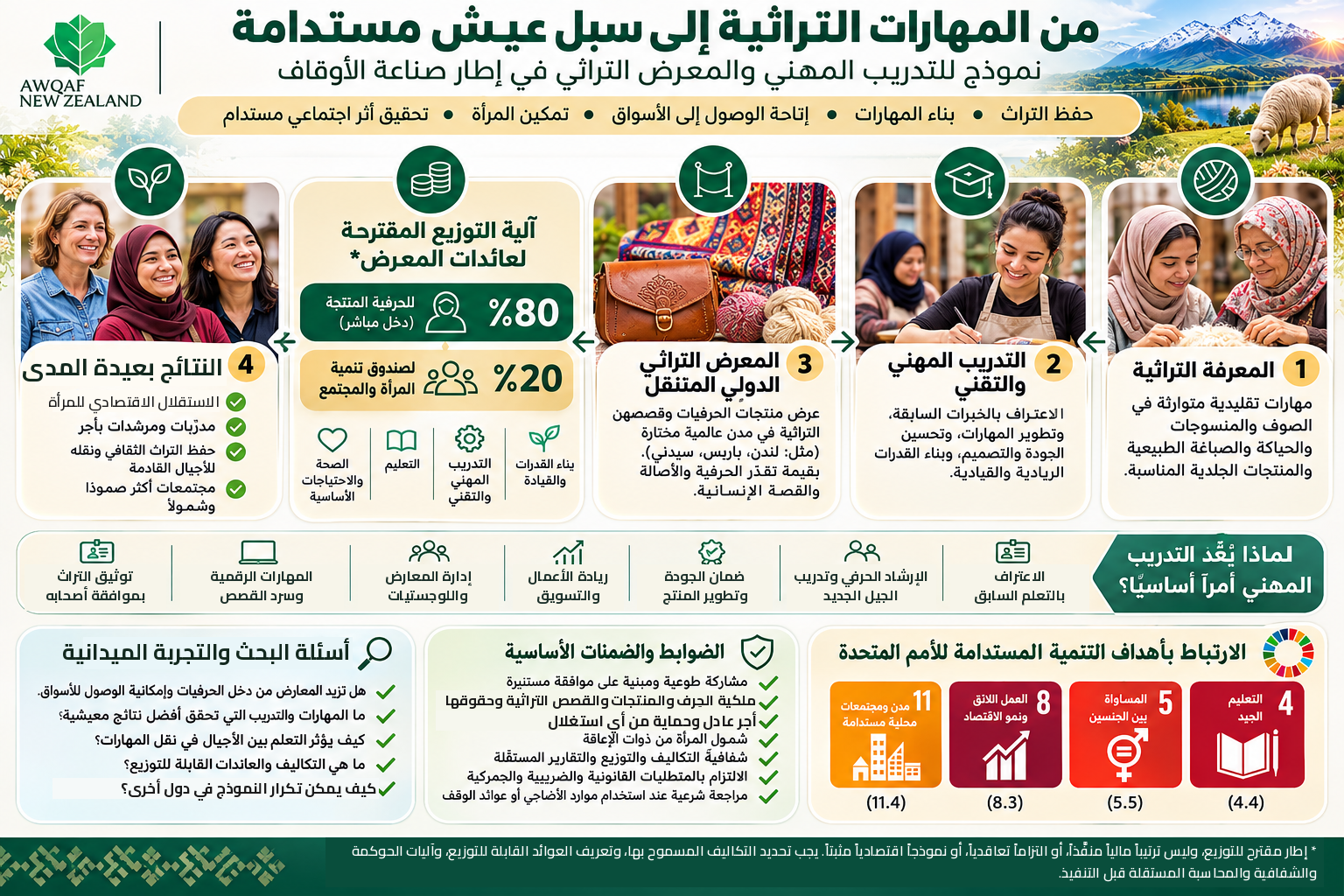
AI tools assisted with the drafting, structuring and translation of this paper, including ChatGPT (OpenAI) for an earlier draft and an external fact-check, Gemini (Google) for an Arabic language review and a Google for Nonprofits compliance check, and Claude (Anthropic) for the final edition and the Arabic translation. The two infographics (Figures 1 and 3) were produced with AI image tools for Awqaf NZ; Claude corrected text errors in them. Awqaf New Zealand is responsible for the content. Facts about Awqaf NZ's history were checked against its institutional records; claims about outcomes are deliberately absent because none have yet been measured.
University and research relationships. Awqaf New Zealand engages with academic institutions under an open-access research framework. Mention of specific universities or research facilities reflects exploratory technical discussions, academic scoping, or publicly available research capabilities, and does not imply a formal legal partnership, financial endorsement, or exclusive joint venture unless formally executed under a written agreement.
Technology platforms and trademarks. Awqaf New Zealand utilises enterprise software, cloud infrastructure, and digital tools provided under approved non-profit programmes (including Google for Nonprofits). All product and company names are trademarks or registered trademarks of their respective holders. Mention of them is for factual identification of digital tools used and does not imply direct sponsorship, endorsement, or legal partnership.
Licence. CC BY-NC 4.0. The Awqaf New Zealand name and logo are excluded from the licence; third-party material remains subject to its own rights.
Contact. Awqaf New Zealand · registered charity CC46694 · 200 Kaipara Road, RD 2, Papakura 2582, New Zealand · awqafnz.org · DOI 10.5281/zenodo.24253676
Version 1.1 is a targeted enhancement, not a general rewrite. Its purpose is to give appropriate prominence to Awqaf NZ's historical proposal for a Heritage Skills International Touring Exhibition and Women's Economic Empowerment Model. The title, thesis, verified external facts, citations and disclaimers of Version 1.0 are retained.
| Section | Change |
|---|---|
| Front matter, abstract | Version 1.1 status note; citation updated; one abstract sentence and three keywords on the touring exhibition model |
| 2. Historical roots | Touring exhibition concept added (London, Paris, Sydney contemplated; never implemented); table separating documented events from unimplemented proposals |
| 4. Women as leaders | New "From knowledge holders to leaders" progression; 80/20 detail moved to 6.4.3 to avoid duplication |
| 5. Skills architecture | Domain C expanded: RPL, quality assurance, costing, curation, logistics, digital marketing, documentation with consent, IP |
| 6.4 Heritage skills | Retitled and expanded: the five-step model, the untested market hypothesis, dignity in storytelling, why VET is essential, the proposed 80/20 allocation and its status, a women-governed 20% option, getting payment safely to women in refugee camps, historical versus future cities; new 6.4.5 on exhibiting in communities where Qurbani is offered (public education as a secondary purpose, provenance rules, artisans not promotional instruments); Figure 1 added |
| 7. SDGs | New row for the touring exhibition model (4.4, 5.5, 8.3, 11.4); note that mapping implies no UN recognition or demonstrated impact |
| 11. Pilot sequence | Historical and current cities distinguished; six gate conditions before any exhibition |
| 12. Measuring | Eight exhibition-specific indicators; five proposed public education and Qurbani-offeror engagement indicators |
| 13. Safeguards | Seven exhibition-specific safeguards, including no conditionality on humanitarian assistance |
| 14. Research questions | Eight new questions on income, demand, costs, training outcomes, mentoring, the community fund and offeror engagement; "Future reviews" note on legal, logistics and constructive criticism |
| Statements, Appendix B | AI statement notes the infographics; Arabic infographic added (now Figure 3) |
| Section (page) | Change |
|---|---|
| Front matter (p. 2) | Status note records revision 4 |
| 2. Historical roots (p. 5) | Link from the c. 2005 Christchurch wool proposal to section 6.4.6, without implying delivery |
| 6.4.6 (pp. 15 to 17) | New subsection: core principle; Pathway A (resettlement schools and learning centres); Pathway B (refugee camps and displacement settings); shared framework; safeguarding and consent; relationship to the exhibition (not a production pipeline; 80/20 does not apply to school or camp training); Figure 2 two-way network diagram |
| 7. SDGs (p. 20) | New row for the two pathways (4.4, 5.5, 11.4), aligned by interpretation only; SDG 12.3 not used for wool or hides |
| 11. Pilot sequence (p. 23) | Eight-stage sequence for the pathways; resettlement and camp pilots assessed separately |
| 12. Measuring (p. 25) | Ten candidate indicators, no baselines or targets |
| 13. Governance (p. 26) | Eight governance requirements, including approvals, child protection and the right not to participate |
| 14. Research questions (p. 28) | Seven reviewer questions added |
| References (p. 30) | [14] ASQA and training.gov.au; [15] NZQA; [16] UNESCO ISCED 2011 |
| Appendix B (p. 35) | Arabic infographic renumbered Figure 3 |
| Section | Change |
|---|---|
| 6.4.1, 6.4.2, 6.4.3 | Local-market displacement note; RPL barriers for displaced artisans; waqf versus restricted fund trade-off for the 20% |
| 6.4 Figure 1 caption | Attribution harmonised; historical cities in step 4 clarified |
| 6.5 | Equity limits of AI: lower-resource languages, device access |
| 14 | Wakalah question for Shariah bodies; four research clusters linked to section 11; future-review items listed |
| References | Full URL for ILO No. 208 |
| 6.5, 7 (v1.1 overall) | SDG 9 tag narrowed to 9.c (recorded for completeness) |
| Infographics | Further Arabic text errors corrected in the Arabic infographic (research questions heading and bullets, safeguards bullets, footnote) |
Infographic corrections by Claude. Figure 1: em dashes in "Our Vision" replaced with commas; a stray character after the Shariah review line removed. Figure 3: the row "Why is vocational training essential?" contained garbled and duplicated labels, now corrected (recognition of prior learning; craft mentoring and training the next generation; quality assurance and product development; entrepreneurship and marketing; exhibition management and logistics; digital skills and storytelling; heritage documentation with consent); "economic independence for women" corrected in the outcomes card. The people depicted, and their diversity, are unchanged.