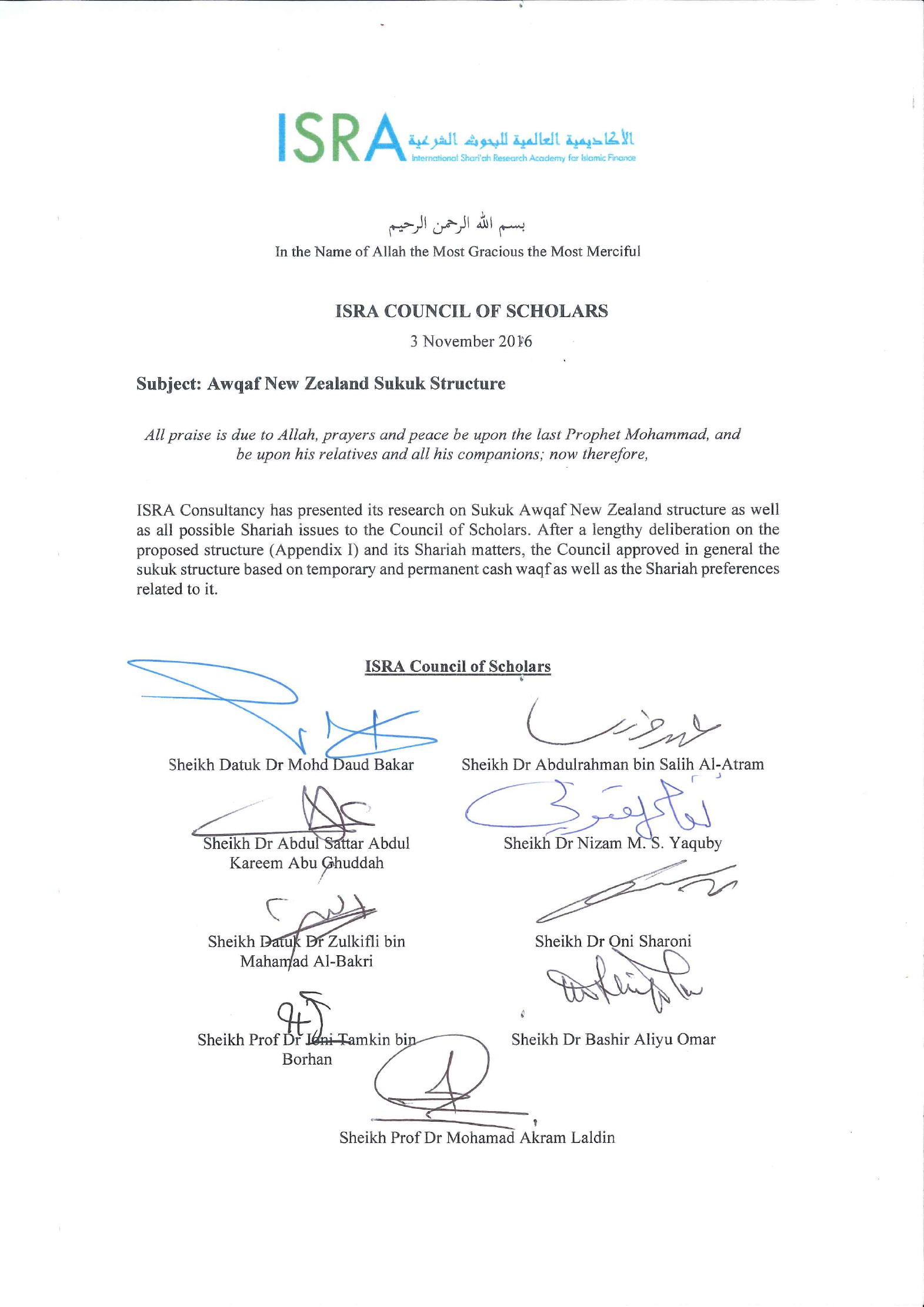
ISRA Council of Scholars — Formal Approval
On 3 November 2016, the ISRA Council of Scholars reviewed and approved Awqaf New Zealand's cash-waqf sukuk structure — built on temporary and permanent cash waqf. The approval was signed by nine of the world's leading Shariah scholars.
Salma — Ready-to-Eat Halal Relief Meals
Salma is an internationally recognised humanitarian relief programme that Awqaf New Zealand was proud to help catalyse. It delivers ready-to-eat, long-life, 100% halal meals — sourced from New Zealand — to victims of wars and disasters worldwide.
This formative work continues to shape Awqaf New Zealand’s relief effort and our Zero-Waste Qurbani model, which draws directly on the Salma approach.

Scholarly Validation & Regulatory Alignment
Awqaf New Zealand's model is grounded in jurisprudential adaptations reviewed by leading international authorities in Islamic finance and contemporary waqf codification.
Global Collaborative Alliances
Our cross-border collaborations are designed to bridge supply-chain gaps and advance food-security goals through cooperative ventures with state and academic institutions.
University Research Partnerships
Open to expressions of interest
Awqaf New Zealand has designed a research-partnership programme across five postgraduate tracks: smart agriculture and IoT through digital waqf financing; generative AI and cross-cultural visual literacy; renewable energy and the circular economy; and vocational training and workforce development — our farms are training farms from their first day, replicating a New Zealand model that has worked for a century under public-trustee oversight. Two open aims: to subject the model to independent academic scrutiny and publish every finding freely as a waqf of knowledge; and to help train a younger, bilingual generation able to carry the work forward. Anchored in New Zealand, open to universities and research centres internationally.
For more information, see Research →
No agreement has yet been concluded with any university. Partners will be named once agreements are signed.